 Myron Wittmer●
The Catalog Is the Wrong Place to Start
Legacy cabinet software often starts with a catalog, then piles on folders and subfolders to keep it organized. That may have made sense once. But for real shops, it usually turns into a mess nobody trusts. Grainwork is being built to start with types and presets instead, because shops build cabinets. They do not manage libraries.
The catalog model made sense once.
But in the cabinet software I’ve seen, catalogs tend to get messy over time. The folders get messy. The subfolders get messy. Things get copied, renamed, buried, and half-fixed until nobody really trusts what’s in there anymore.
A lot of legacy cabinet software starts with a catalog, then adds folders and subfolders to keep the catalog organized.
That sounds reasonable until you actually live with it.
Cabinet shops are builders. They should not have to spend their time acting like librarians just to get a cabinet into a job.
The real problem is not just the mess. It is that the catalog puts the software in charge of a structure that does not match how shops actually think.
1. The catalog becomes a maintenance problem
What starts as a neat library slowly turns into a pile of versions and exceptions.
Someone creates a new entry because the old one is close but not quite right.
Someone else copies that one and changes it again.
Before long, the catalog is full of near-duplicates.
2. Folders and subfolders do not fix the core issue
A bad structure does not get better just because you give it more folders.
It usually gets harder to navigate.
You are not really solving the problem. You are just creating more places to lose things.
3. Legacy catalogs drift over time
This is why you end up with names like “std base” and “std base 2.”
Nobody planned for that. It just happens.
One designer needs a variation, another makes a copy, and the next person inherits the mess.
4. Shops do not think like libraries
A shop does not start by asking, “Which item in the catalog should I pull?”
It starts by asking, “What kind of cabinet is this?”
That is a better place to begin.
5. Types, subtypes, and presets fit the work better
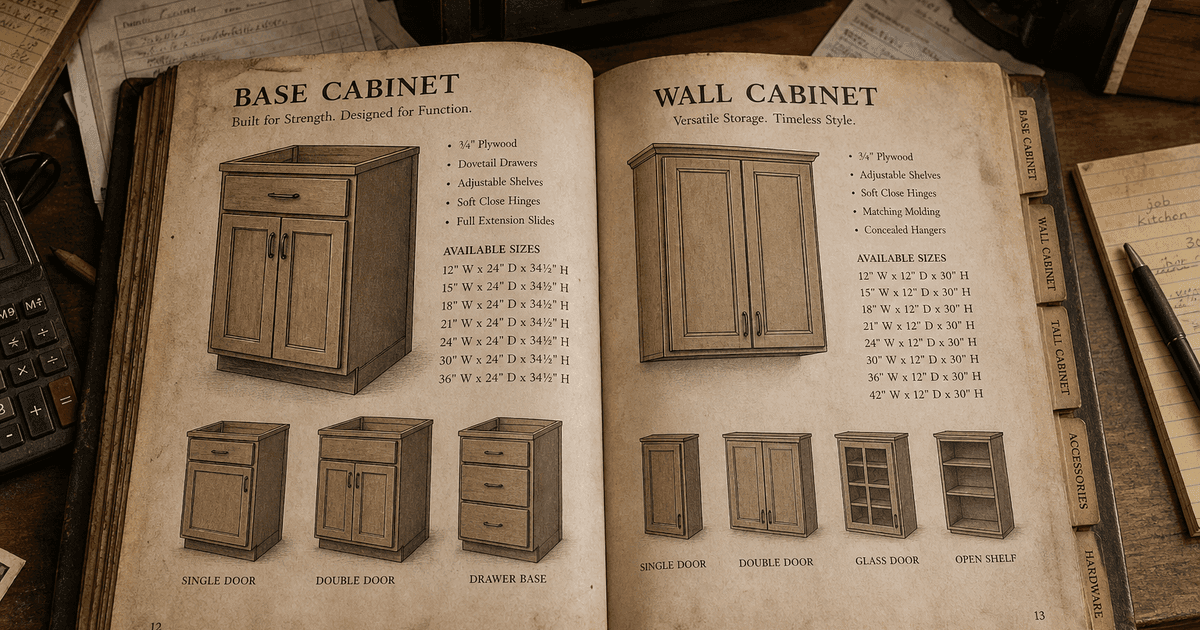
Base, wall, tall, sink base. That kind of structure makes sense.
Then you can use subtypes and presets for the variations shops actually build.
That gives you structure without forcing everything into one giant catalog tree.
Naming matters, but it is not the whole story
Better naming can help, and I want to come back to that separately.
But naming does not fix a bad catalog.
If the structure is wrong, the names just end up drifting with it.
Cabinet software should not force shops into a catalog-first way of working.
The catalog model was built for software that behaved like a lookup table.
That is not enough anymore.
Grainwork should start with types and presets that match how shops actually build, instead of making people manage a catalog that gets messy the moment real work hits it.

Myron Wittmer
Myron Wittmer is the founder of Grainwork and a cabinet software consultant. He’s spent years helping cabinet shops fix broken setups, untangle workflow problems, and get more control over the systems they rely on. Grainwork is his attempt to build the cabinet software he kept wishing he could recommend.