Software Isn't Dead Just Because Anyone Can Build It
Oct 2, 2026
Grainwork is cabinet design and manufacturing software for production shops. Design cabinets, produce drawings and cut lists, prepare CNC output, and change your cabinet standards without a consultant.
Join the shops building the alternative · no pitch, no spam
In closed beta. See pricing and launch plans.
You buy the software.
You pay for the setup.
You pay for the training.
You pay for support.
You pay again when your shop changes.
And somehow, after all that, you still cannot fully control the most important tool in your building.
When you need to change a construction method, add a new drawer guide, create a custom door standard, or adjust a report, now you need a consultant, a script, a support ticket, or a workaround.
The features are technically there. The control is not.
Software got better. Hardware got better. Cloud became normal. Modern tools became easier to learn, easier to run, and easier to change.
In too many shops, the software is still the one tool that demands a specialist to operate, a workstation to babysit, and a paid expert to translate what the shop already knows. That is the old model. We are not interested in preserving it.
We said one honest thing about cabinet software. Within days, shops wrote back. Owners, designers, production managers, describing the same problems in almost the same words. None of them had compared notes. They didn't need to. What follows is real, pulled straight from those replies.
We pay for seats nobody else can use.
Every task takes hours and hours just to set up.
Honestly, I'm ready for something new.
We lost weeks of work when an update broke our database.
Paying every year for support that never comes.
The slowness on a big job is its own kind of exhausting.
We feel like we need to be computer wizzes just to get a job out the door.
We just lost the guy who finally learned the system.
Too much of how we build lives in one person's head.
I don't have time to relearn it every update.
I'd love to kick it to the curb.
We've already walked away from it.
I'm holding off on a big purchase to see this first.
Everything you wrote is how I already felt.
None of this is unusual. That is the problem.
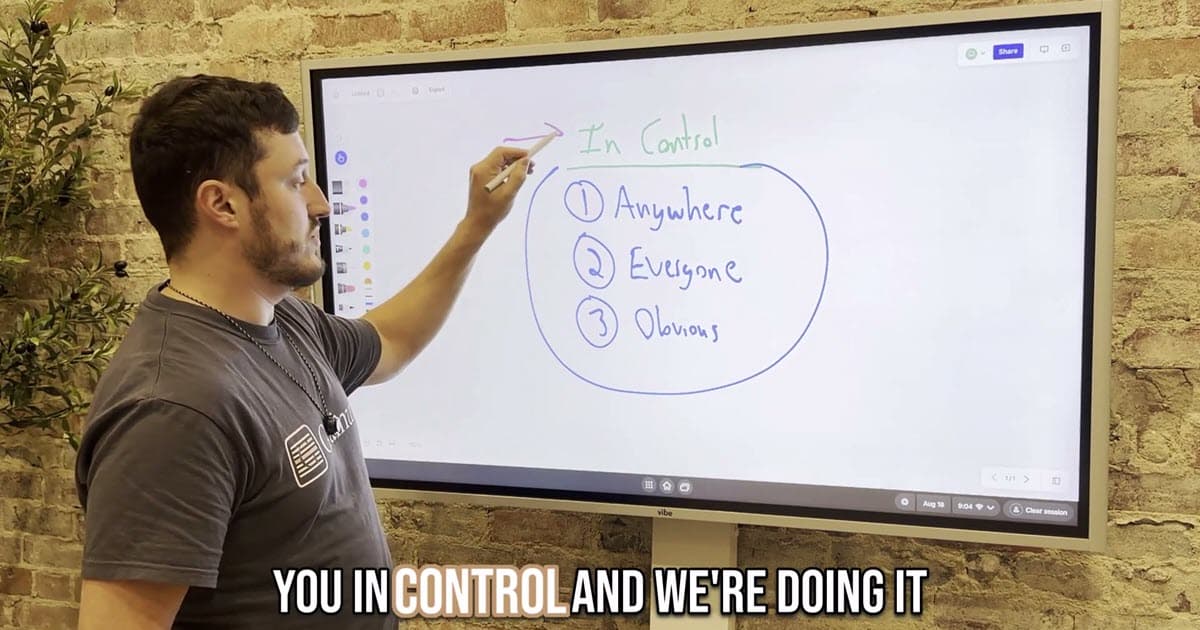
Grainwork is cabinet software for shops that actually build cabinets, design all the way through to manufacturing. Everything we build comes back to three ideas. Here they are, and here is what the software looks like today.
Running your software shouldn't be somebody's job. No server in the corner, no IT company, no installs, no license codes. You open a browser and the job is there, and it's the live one.
Everybody who touches a job should be able to see it, not a printout from two weeks ago. Shop seats are free. You pay for the people designing the job, and the rest of your shop gets their own login.
Every feature gets one test before we build it: can almost anybody figure this out on their own? Not custom programming. Not a SQL query. Not a formula nobody can read in six months. That rule costs us features, and we're fine with that.
AI helps with setup, system changes, and maintenance. The cabinets, rules, and shop output still need structure. That is how you make software easier to use without making the results harder to trust.

I started on the shop floor. Since then I've worked one-on-one with cabinet shops, fixing broken setups, untangling construction standards, writing scripts, and helping teams get control of systems they already paid for but still couldn't really use.
After enough years doing that work, one thing became impossible to ignore: good shops were carrying too much software burden just to get dependable output. The industry got used to it. I don't think it has to stay that way.
Grainwork is the tool I kept wishing I could recommend.
“Farther ahead than what I had anticipated.”
Three of our first shops said a version of that, independently, when we asked the same closing question. That is fair. Up to now, most of what anyone had seen was an email and a short clip. There will be a lot more video from here, and more chances to see Grainwork for yourself. Here is what it does today.
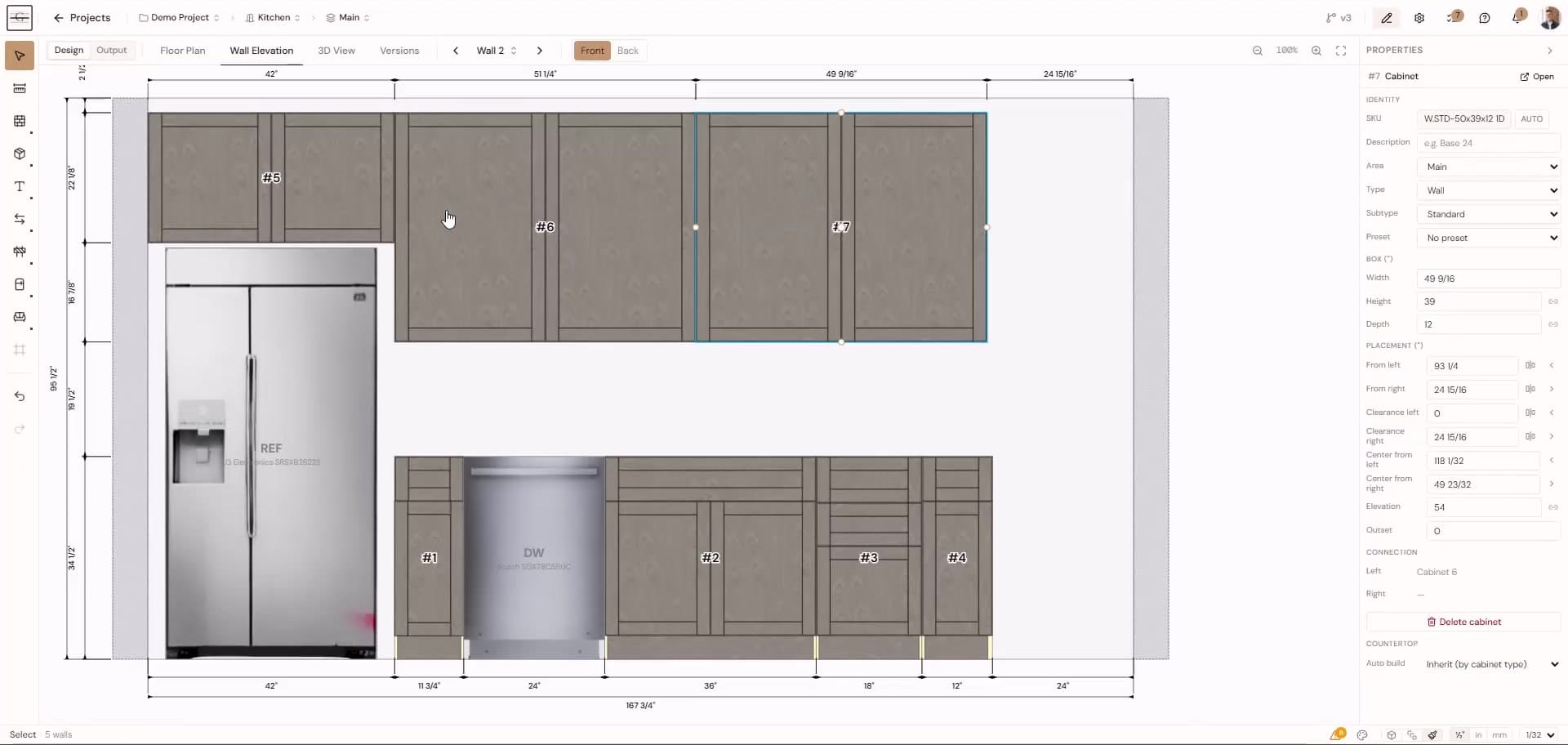
Walls, cabinets placed on those walls, elevation views. Resize a cabinet, open it up and change its details. Wireframe and render modes for however you like to work.
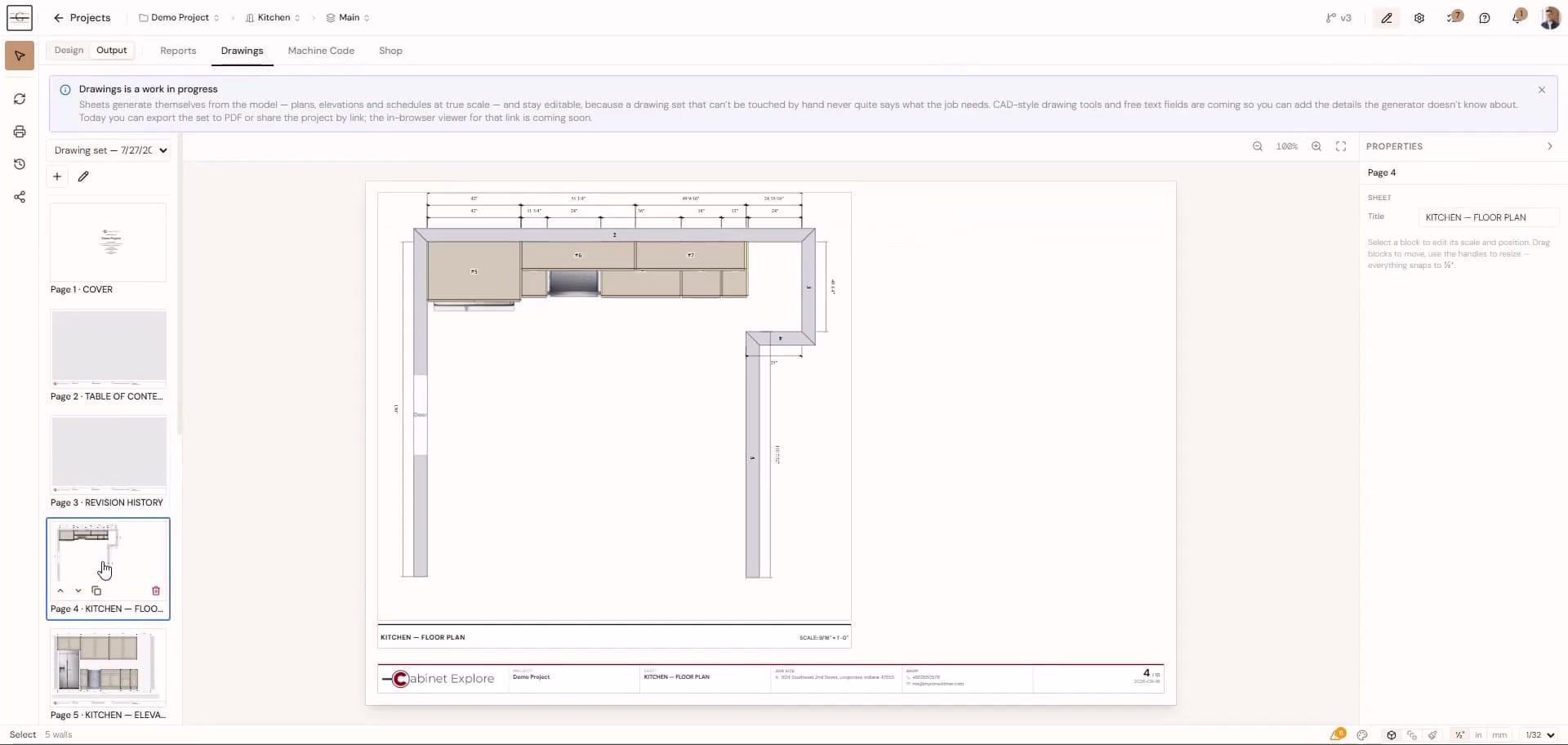
How your customer and your shop see the job. Plans, elevations and schedules, generated from the job you already drew. Once it is drawn, you should not have to draw it again just to print it.
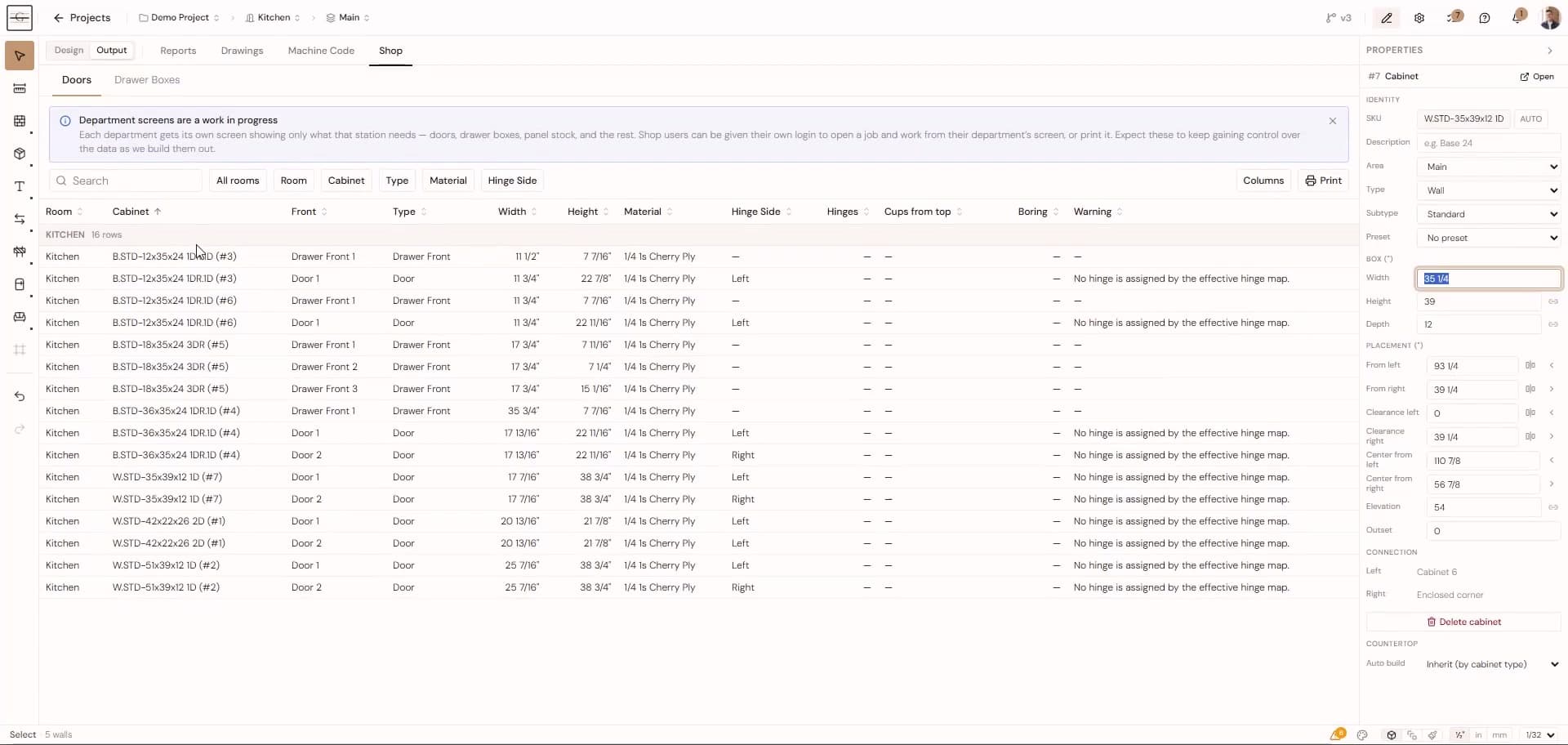
Cut lists, door and drawer information, and views for each department. Your shop can see the job without walking to the office to find out what is going on.
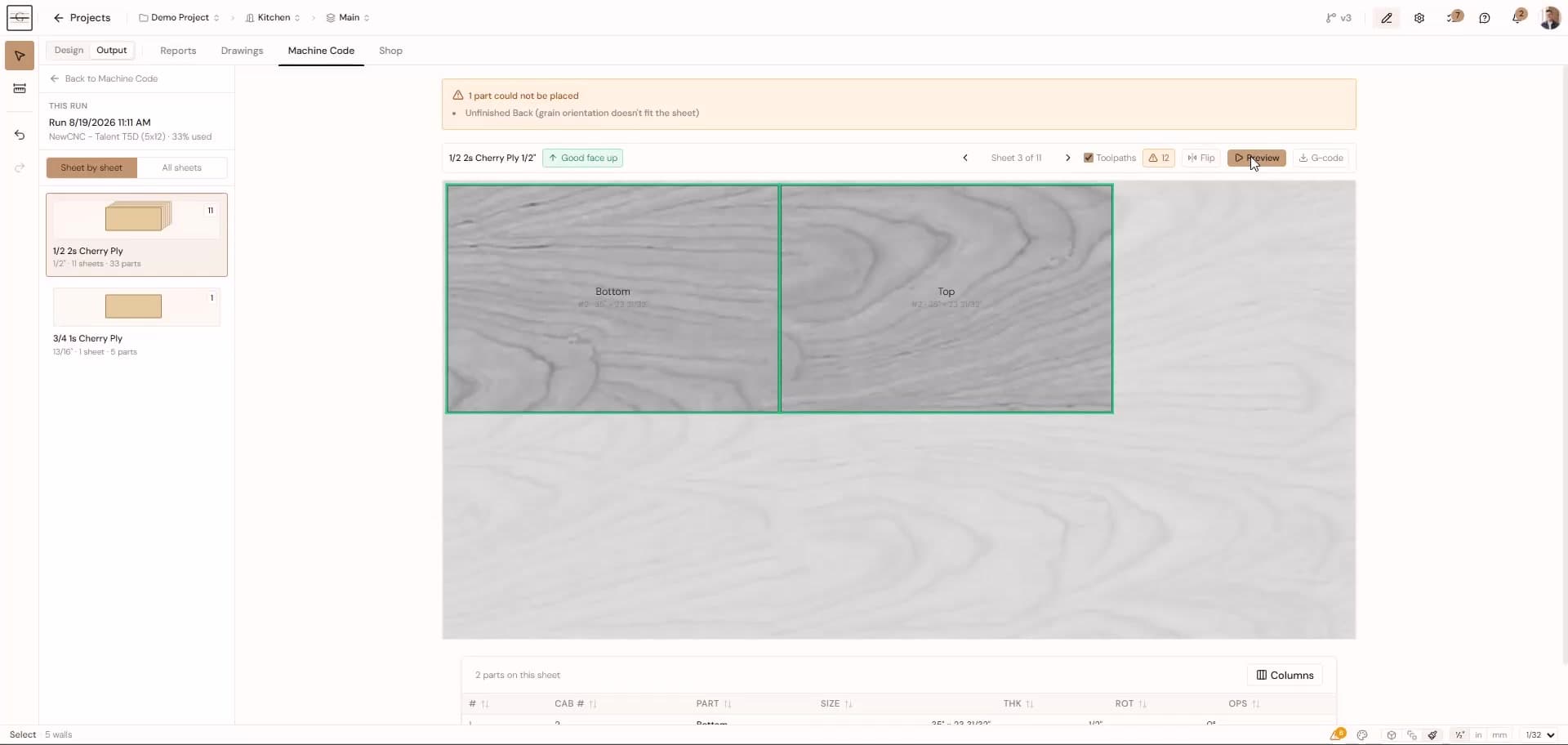
Filter the parts, pick your machine, optimize. Sheet layouts that respect grain direction, toolpaths you can look at before anything gets cut, and a file for the machine.
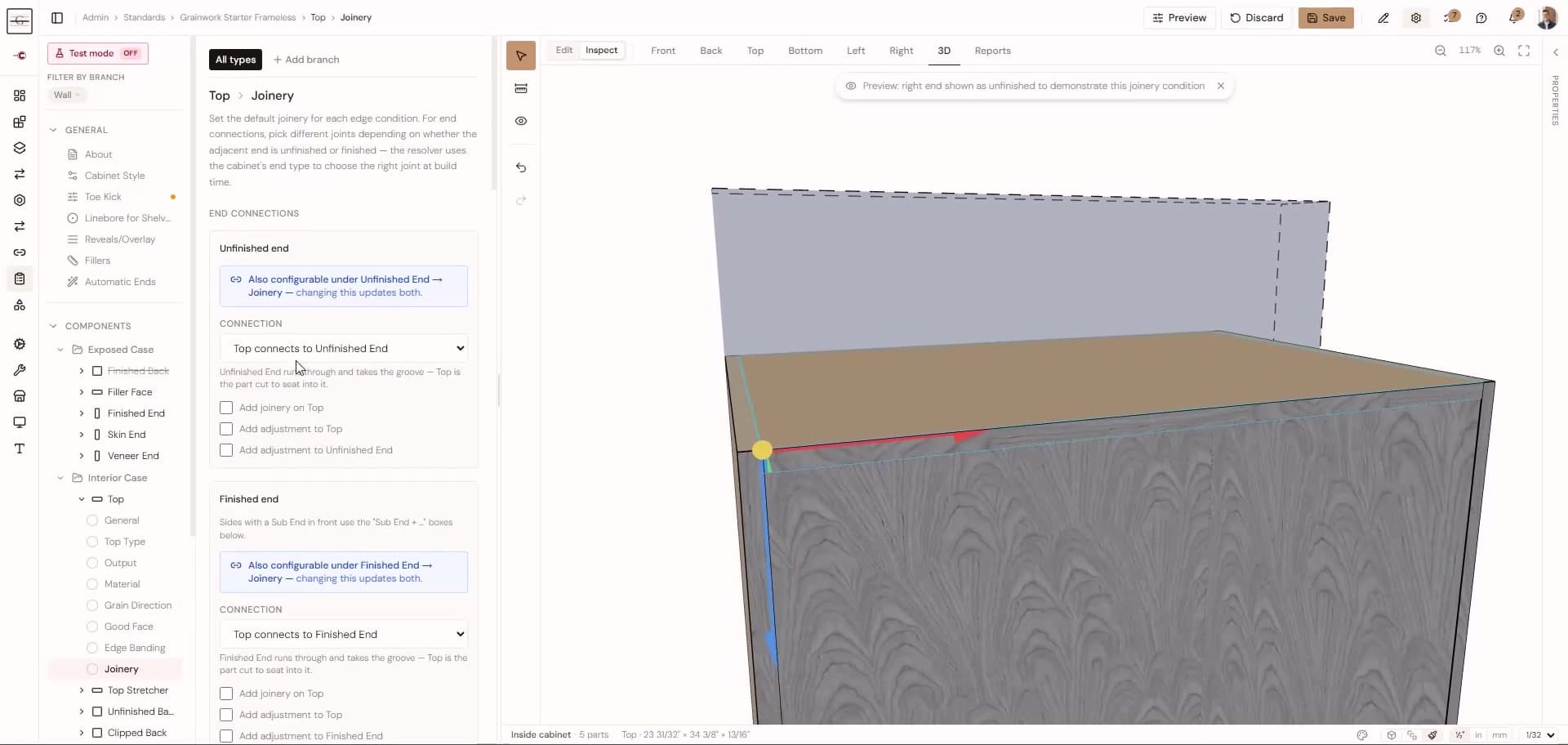
Click a setting and it zooms to the area it affects, so you can see what you are choosing before you choose it. That is what obvious looks like in practice.
Grainwork is under active development. The focus is the core workflow a production shop has to trust before anything else matters: room layout, cabinet logic, shop setup, and manufacturing output.
The goal is not to ship the longest feature list. The goal is to build the part of the system a shop can actually run work through.
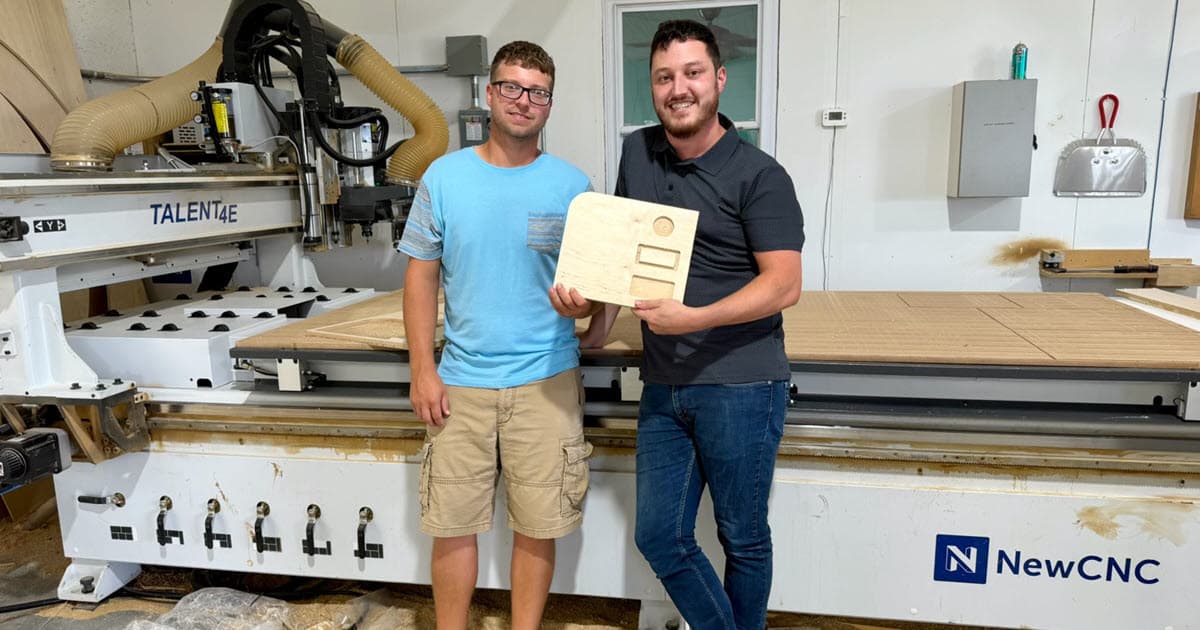
Stay informedA real part, cut on a real machine, from a job drawn in Grainwork.
Our first shops start running real work through Grainwork. We are onboarding more every week.
Beta shops run real jobs. We find the obvious bugs, make it easier to use, and build what they tell us is missing. This is the hardest phase to put a date on.
Grainwork opens to the public. We will likely cap signups per week so onboarding and support stay solid.
Signup caps come off. New customers come in at standard pricing.
These are targets, not promises. They are where things stand today and they are subject to change. We will only release when the product is ready.
 Myron WittmerMyron WittmerMyron WittmerMyron WittmerMyron Wittmer
No.
There are a lot of AI-built apps hitting the market right now, and a lot of them feel like they were put together fast just because the tools made it possible. That is real. The barrier to entry dropped hard, and the build-versus-buy landscape has changed fast, especially in the last year.
I am using AI heavily. I think that would be stupid not to.
But this is not a one-prompt build, and it is not an app where AI is making random cabinet decisions and hoping they work out. Grainwork still has to be planned, architected, tested, and built around how real shops actually work. It has to reflect how cabinets are constructed, how machining works, how output gets trusted on the floor, and how users actually think when they are trying to get a job out the door.
That part does not come from hype. It comes from experience.
What AI changes for me is speed. It helps me build faster, test ideas faster, and lower the cost of creating software. What it does not replace is software architecture, product planning, CAD and machining understanding, user testing, or thinking carefully about how the system should behave when a shop depends on it.
So yes, AI is a big part of how Grainwork is being built.
But the real differentiator is not that AI touched the code. The differentiator is the product itself: how it is structured, how it is tested, how the workflow is designed, and whether it actually solves the right problems for cabinet shops.
That is the standard I care about.
You can. Some shop owners already are, and I get why.
I am doing the same thing. Grainwork is being built with AI too, so I am not going to tell you it can't be done.
But getting a first version working is the easy part. Something that draws a cabinet and prints a cut list can come together pretty fast now. The hard part is everything after that.
It is the post that has to run on your machine without driving a bit into the spoilboard. The hardware catalog that changes when a vendor updates a slide. The corner cabinet that has to come out the same in the drawing, the cut list, and the CNC file. The bug that only shows up on the job that has to ship Friday. The new hire who needs to learn the system without you standing over their shoulder.
None of that is a weekend project. It is years of work, and it never really stops.
If you love building software and have the time, go for it. Seriously. But most shop owners I know did not get into this business to maintain code. Every hour spent fixing your own software is an hour not spent designing, selling, or building cabinets.
That is the work Grainwork is trying to take off your plate. And if there is something specific you need, tell us. We would rather build it once for every shop than have you build it alone.
A lot of the software in this space was built in a different era, and it shows.
Yes, part of the problem is the stuff users feel every day. Windows-only environments. Buggy behavior. Hard installs. Slow learning curves. Systems that take too much effort just to keep running. That part is real.
But the deeper issue is underneath all of that. A lot of these platforms are built on decades-old code and old assumptions about how software should work. That makes it harder to rethink the product in a serious way. Harder to simplify the workflow. Harder to build better integrations. Harder to take advantage of AI in a useful way. Harder to connect with the newer tools, automations, and systems that modern businesses are starting to rely on.
That gap is only going to get bigger.
Grainwork is different because it is being built around a more modern foundation from the start. The goal is not just to make cabinet software look newer. The goal is to make it easier to use, easier to maintain, easier to connect, and easier to keep moving forward as the industry changes.
That matters because cabinet shops do not just need software that works today. They need software that can keep up with where business, manufacturing, and technology are going next.
Grainwork is for production cabinet shops that want a better way to get from layout to manufacturing output.
It is for shops that care about how the work actually gets built. Shops that need reliable part data, clear output, and a system that does not take a full-time expert just to keep it running.
It is a good fit for owners, production managers, lead designers, engineers, and technical people inside a shop who are tired of carrying too much software burden just to get dependable results.
It is especially for growing shops that have outgrown spreadsheets, workarounds, and older systems that take too much setup, too much maintenance, and too much effort to trust.
If your shop wants stronger manufacturing capability in a system that is easier to learn, easier to manage, and easier to build on, that is who Grainwork is for.
No.
A lot of cabinet software expects you to think like a drafter. Draw lines, snap points, build boxes, then hope the parts that come out match what you meant.
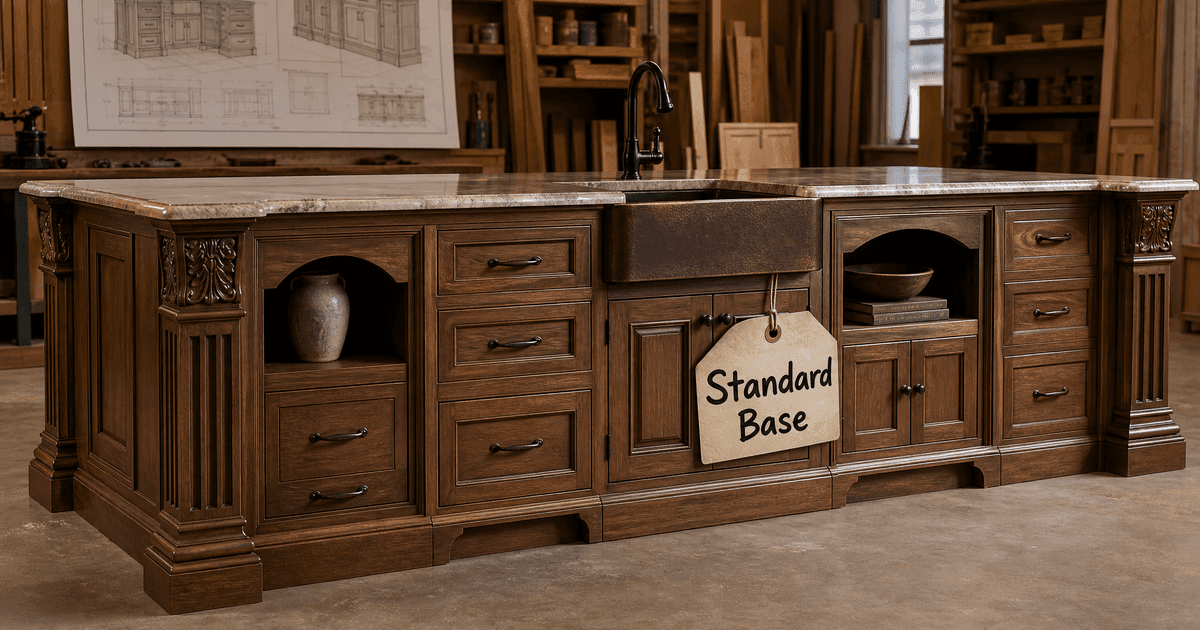
Grainwork works the other way. You lay out the walls, place the cabinets, and type the sizes you want. Your shop's standards handle the construction: materials, joinery, reveals, hardware, and machining. The drawings, cut lists, and CNC output all come from that same cabinet, so you are not drawing the same thing three times.
If you can measure a kitchen and you know how you want it built, you can design in Grainwork.
There is still a learning curve. Any software that drives a CNC has one. But what you are learning is how your shop builds cabinets, set up once. Not how to drive a drafting program.
We will add it.
Every shop's machine setup is a little different, even on the same brand. Tool tables, spoilboard habits, the way the controller wants its code. That is normal.
Send us a sample program that already runs on your machine. We match our output to it, and your post gets its own version, so a change made for another shop never changes yours.
There is no extra charge per machine. If you run three machines, you get three posts.
We would rather do that work once, carefully, than have you guess at settings and find out at the router.
Grainwork is $99 USD per user, per month.
Anyone who needs to make changes is a paid user. Shop floor staff, production managers, and customer views are free.
There are no tiers, no add-on modules, no per-machine fees, and no setup cost charged separately. The whole price is on the pricing page.
It is a bill. But for most shops, it is one of the smallest ones.
Look at where the money in a shop actually goes. Labor. Material. Machines. Rent. Then look at where the time goes. Redrawing a job because the layout changed. Entering the same cabinet in two different programs. Recutting a part because the cut list was wrong. Walking out to the floor to answer a question the drawing should have answered.
That is where the real cost is.
If a designer costs you $30 an hour, $99 a month is about three hours of their time. If the software saves them one hour a week, it has paid for itself. If it saves one recut sheet of prefinished plywood a month, same thing.
Cheap software that wastes your time is expensive. Software you built yourself and have to keep fixing is expensive too.
The better question is not what the software costs. It is what it costs to run your shop without it working well.
Switching software is a big decision. I do not take that lightly.
A lot of shops have thousands of dollars, years of setup work, and a lot of hard-earned knowledge tied up in the systems they already use. That is real. Even when the software is frustrating, switching still feels risky because you are not just replacing a tool. You are touching workflow, output, training, and the way the shop gets work done every day.
For a real production shop, I would not recommend a hard stop and switch.
The better path is to get access, run through some jobs, test a cabinet, validate the output, and build confidence over time. Then, once the system proves itself, you can start making a more complete transition away from the old one.
That is especially true because Grainwork is still an early stage product. It is going to take a little time to earn that trust. But that is exactly how it should work. Software that affects real shop output should be proven, not blindly adopted.
If your current system is still serving you well, keep using it.
But if you already know the cost of staying is adding up, it makes sense to start testing what comes next.
Grainwork is being built for shops that want to make that move carefully, practically, and with a clear eye on the future.
Not the consultant. Not the IT contractor. Not the vendor's support queue. The shop.
We're giving shops back to themselves.
Add your shop to the list. You'll get honest updates as we build, and you'll be first in line when the next group opens.
Read the full manifesto →