 Myron Wittmer●
We’re Not Building an AI That Designs Your Kitchen
Every cabinet software company wants to talk about AI right now. But cabinet design is not a creative writing task. A cabinet has to go together in the real world. Grainwork’s AI direction is not about replacing designers. It is about helping them navigate rules, configuration, and troubleshooting faster, without asking them to trust a black box.
We are not building an AI that designs your kitchen.
That might sound strange to say right now, because every software company seems to be racing toward the opposite message.
The pitch is usually some version of this: type what you want, and the AI designs the kitchen for you.
It sounds impressive.
I do not think it is the right promise for cabinet software.
Cabinet design is not a creative writing task.
It is not a brainstorming session where “close enough” is good enough.
A cabinet has to be the size it has to be. The grain has to run the right direction. The hinge has to clear the adjacent panel. The dado has to be in the right place. The parts have to fit together.
Those are not opinions.
They are rules.
And when software is responsible for producing something physical, plausible is not good enough.
That is the problem with a lot of AI talk in this industry. It treats cabinet design like the main goal is generating something that looks believable on a screen.
But shops do not need believable.
They need correct.
1. AI should not be guessing at engineering truth
Modern AI is very good at producing plausible answers.
That is useful in the right context.
But plausible is the wrong bar for cabinet construction standards. If the bottom panel is wrong, if the grain direction is wrong, if a clearance is missed, the result is not “almost right.” It is a problem the shop has to pay for.
Cabinet software should not guess its way through work that needs to be deterministic.
2. The back end still needs rules
Grainwork is still being built around a parametric, rules-driven back end.
Construction standards, materials, joinery, unit types, presets, and project settings all need to behave consistently.
AI should not replace that structure.
It should help people use it.
The AI helps you navigate the rules. It does not replace the rules.
3. The real job for AI is navigation and configuration
This is where AI can actually help.
If a user asks, “Why is my bottom texture coming in upside down?” the useful answer is not a vague paragraph about materials.
The useful answer is: “Your current construction method has the bottom set to face down. Would you like to change it to face up?”
That is valuable.
Not because the AI designed anything, but because it got the user to the right setting faster.
4. AI should help with change requests, not hidden changes
On the project level, there are plenty of places where AI can help plan a change.
If someone says, “Make the island cherry,” the system may need to understand that the island should be grouped as an area first, then the material can be changed.
That kind of help is useful.
But the important part is that the designer still accepts the change.
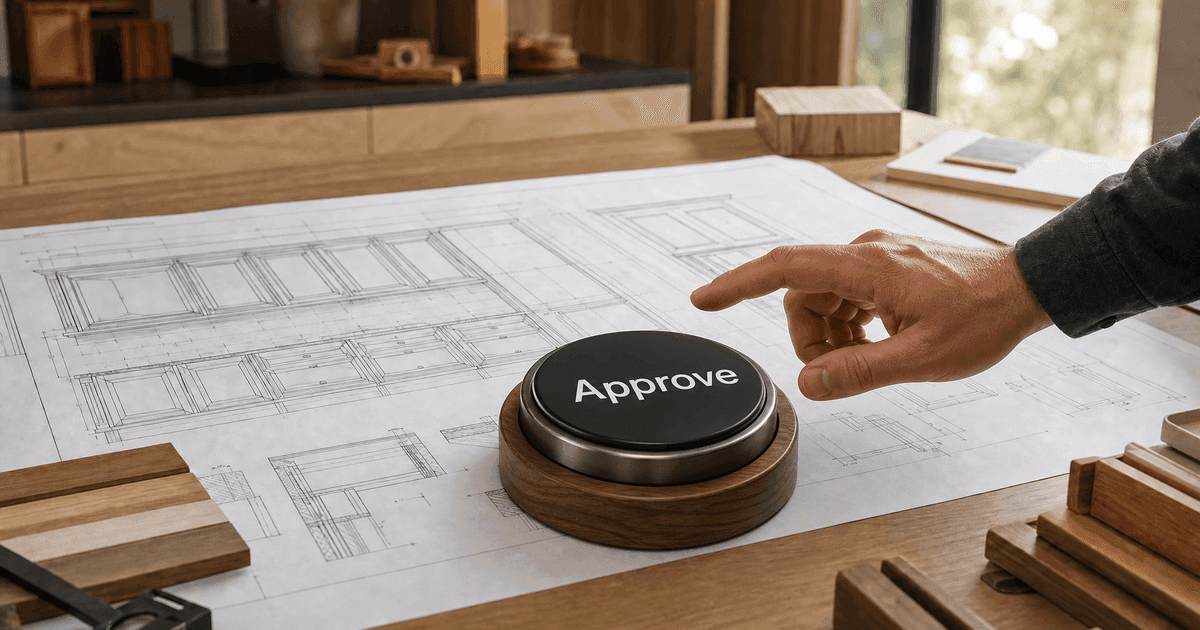
The AI should propose. The user should approve.
The moment software starts making hidden changes to a project file, trust starts to disappear.
5. Support is another place AI can be useful
Every cabinet software company has support tickets.
A lot of those questions are not brand new problems. They are common questions buried inside settings, construction methods, project setup, or material configuration.
AI can help close that loop faster.
It can look at the project, understand the question, find the relevant setting, and point the user toward the fix.
I think AI will play a big role in guiding the user. If it can give someone an instant answer, that is a good thing.
But I also know how frustrating it is when you need something specific and all you get is a chatbot. That does not feel helpful. It makes people angry.
That is not the plan for Grainwork.
We plan to have real human support. A phone number. A person you can talk to when you need help.
AI can be the first layer of guidance, but it should not be a wall between the customer and the company.
That requires a plan. It requires a team. It requires commitment.
AI does not eliminate human support. It helps human support focus on the problems that actually need a human.
6. The goal is not replacing designers
Good designers already know how to design.
What slows them down is not usually a lack of creativity.
It is navigation. Setup. Troubleshooting. Finding the right setting. Remembering where something lives. Waiting on support for a question that should have had answer inside the software.
That is the kind of work AI should reduce.
Not the thinking.
The friction around the thinking.
A cabinet is a physical object that has to go together.
The software that produces it should not be guessing.
That is why Grainwork’s AI direction is not “have AI design your kitchen.”
It is an intelligent helper that understands the project, understands the rules, and helps the designer get to the right answer faster.
The designer still decides.
The rules still matter.
The project file still has to be trusted.
AI should make designers better, not pretend to replace them.

Myron Wittmer
Myron Wittmer is the founder of Grainwork and a cabinet software consultant. He’s spent years helping cabinet shops fix broken setups, untangle workflow problems, and get more control over the systems they rely on. Grainwork is his attempt to build the cabinet software he kept wishing he could recommend.