 Myron Wittmer●
Why Cabinet Shops Get Stuck Depending on Consultants
A lot of cabinet shops think they bought software. What they really bought was a system they can’t fully change without calling somebody else. That dependency costs more than the support bill.
Most cabinet shops do not start out wanting dependency.
They buy software because they want to get work done faster, stay organized, and produce better output. That sounds reasonable. The problem is what happens after the sale.
At some point, the shop needs to change something.
A new construction method.
A different drawer guide.
A custom door style.
A report that matches how the team actually works.
A workflow that fits a new machine or a new way of building.
And suddenly the software is no longer just software.
Now it needs a consultant.
Or a script.
Or a support ticket.
Or a workaround someone built three years ago and nobody fully understands anymore.
That is where cabinet shops get trapped.
The real problem is not the feature set
Most cabinet software can technically do a lot.
The issue is not whether the feature exists.
The issue is whether the shop can actually control it.
That is a very different thing.
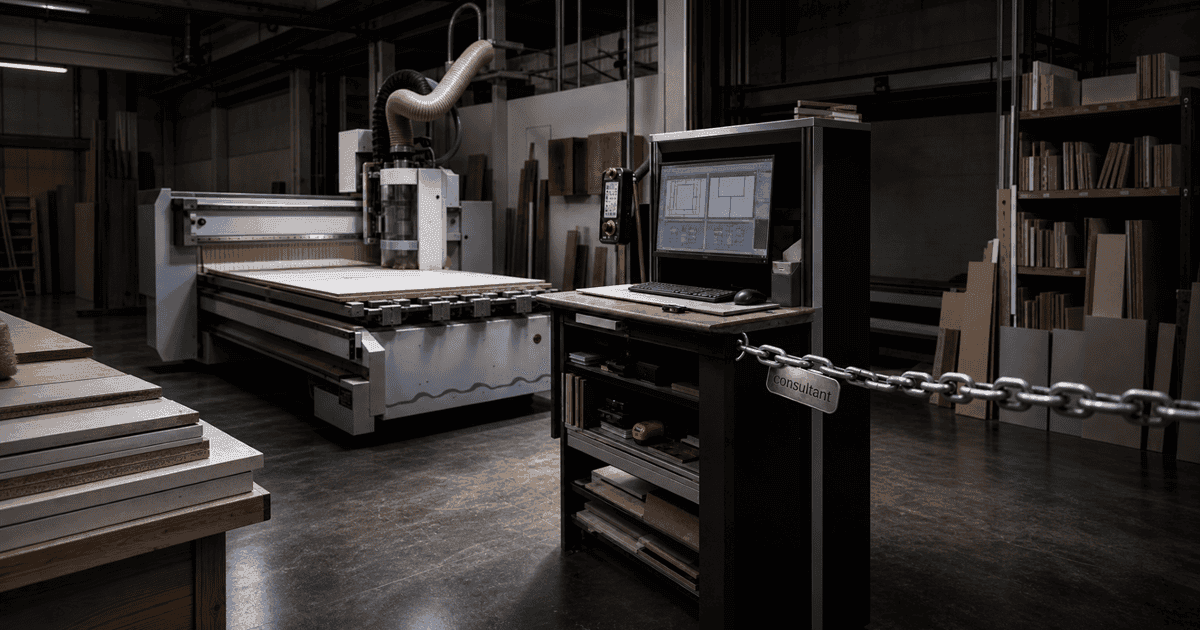
If every meaningful change requires outside help, then the shop does not really own the system. It is renting control. And once that pattern starts, it spreads.
The software becomes harder to trust.
The team becomes afraid to change things.
The shop starts avoiding improvements because every adjustment feels expensive or risky.
That is how dependency grows.
Dependency always costs more than the invoice
Support fees are easy to see.
Lost time is harder to see.
But the hidden cost is usually bigger.
When a shop has to wait on someone else, work slows down. When the system is hard to change, people stop improving it. When the software feels fragile, teams build side workarounds in spreadsheets, notes, and memory.
That creates a second system.
Then a third.
Pretty soon the shop is not running one clean process. It is running a messy mix of software, habits, and tribal knowledge.
That is expensive.
Not just in money. In attention.
The old model trained shops to accept this
For a long time, this was just normal in cabinet software.
The systems were complex. The hardware was clunky. The setup was hard. The industry accepted that you needed a specialist to make things work.
And to be fair, some of that used to make sense.
But the world changed.
Modern software should be easier to set up, easier to adjust, and easier to understand. If every change still turns into a project, the product is built around dependency, not control.
That is the part too many shops have been told to live with.
Functionality matters, but simplicity matters too
This is where the line gets important.
There’s a difference between powerful software and usable software.
My goal with Grainwork is to maximize functionality without filling it with things that only advanced users can really take advantage of.
If a feature exists but most shops cannot use it without deep expertise, that is not much of a feature. It is weight.
Good software should do real work. But it should also stay understandable. The shop should not need a specialist for every meaningful decision.
That balance matters.
Too simple, and the software cannot keep up with real production work.
Too complicated, and the shop loses the ability to actually use what it bought.
The point is not fewer capabilities. The point is fewer useless ones.
What shops actually need
A cabinet shop does not need more complexity.
It needs control.
That means:
Strong defaults so the shop can get moving
Clear structure so changes are understandable
Custom work that does not break everything
Output the shop can inspect and trust
A system that supports the way the shop actually builds
In other words, software should adapt to the shop.
The shop should not have to reshape itself around the software.
Why this matters now
The shops that win are not always the ones with the fanciest software.
They are the ones that can move.
They can change a standard without a delay.
They can adjust output without rebuilding everything.
They can train new people without depending on one expert.
They can grow without turning every improvement into a special project.
That is what control buys you.
Not just convenience. Momentum.
The bottom line
If your cabinet software only works when someone else keeps it alive, that is not a good long-term system.
It might still function.
It might even be familiar.
But it is still dependency.
And dependency slows shops down.
Cabinet shops should own their tools.
They should be able to change their systems.
They should not need permission to do their own work.
That is the problem Grainwork is being built to fix.
If this sounds familiar, you are not alone. A lot of shops have been carrying this burden for years.
It does not have to stay that way.

Myron Wittmer
Myron Wittmer is the founder of Grainwork and a cabinet software consultant. He’s spent years helping cabinet shops fix broken setups, untangle workflow problems, and get more control over the systems they rely on. Grainwork is his attempt to build the cabinet software he kept wishing he could recommend.