Software Isn't Dead Just Because Anyone Can Build It
AI made it possible for a shop owner to build their own cabinet software. For some people that is a great move. For most shops, the subscription is the cheap part.
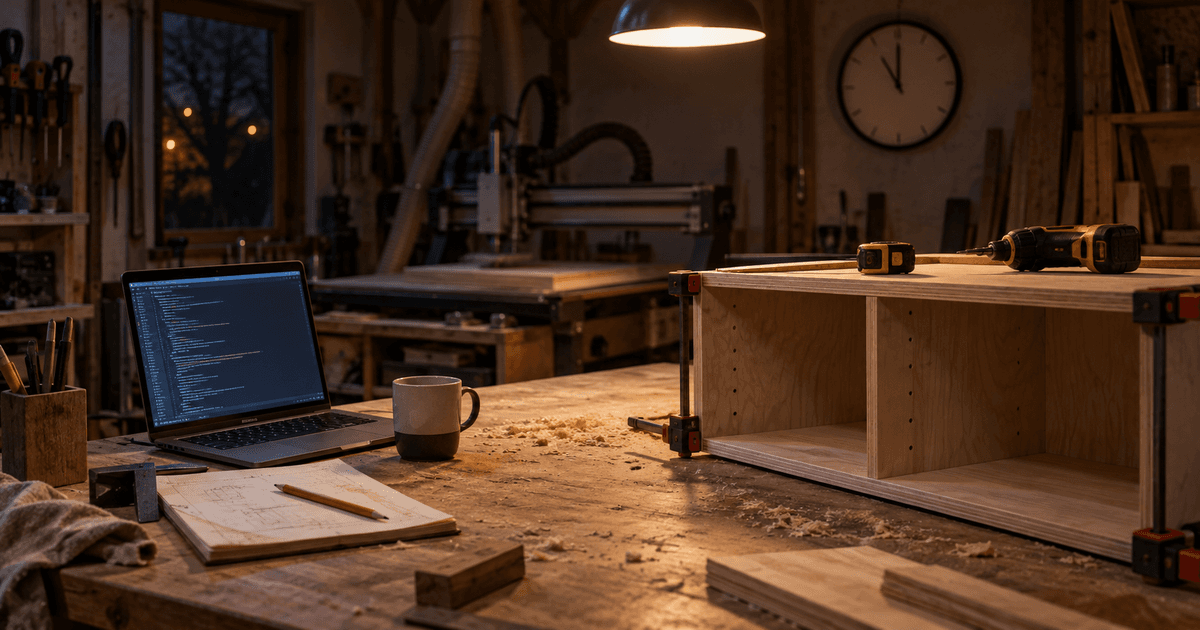
I read a comment recently from a woodworker who has spent the last several months building his own design, estimating, and toolpathing software with AI. When he wants a feature, he describes it and a few minutes later it's done. His take was that the big cabinet software companies are on their way out, and that anyone with a clear vision can now write the software themselves.
I agree with more of that than you might expect.
The barrier to building software dropped hard over the last couple of years. Things that used to take a team of developers months can come together in an afternoon. I'm building Grainwork with AI too. It would be silly not to.
So yes. Anything is possible now. And for some people, building their own is an incredible move.
If you have the time, go build something
I mean that.
If you're the kind of person who loves to tinker, and you have the time, build something. Build the estimating tool you always wanted. Build the cut list that works the way your shop thinks. Fix the scroll bar that has bugged you for ten years.
You will learn a ton. You'll understand your own process better than you ever have, because software forces you to spell out every rule you've been carrying around in your head. And it opens doors. Once you know you can build a tool, you start seeing every problem a little differently.
There is absolutely a pool of people who can do this and will do it well. I'm cheering for them.
Most shops are going to do the math
Most shop owners I know are not short on ideas. They're short on hours.
They're bidding jobs, chasing deliveries, fixing a hinge problem on an install, covering for someone who called in sick, and trying to get home at a decent time. Spending the evening debugging a post processor is not high on that list.
And once you start figuring the value of your time, the subscription stops looking expensive.
Say an hour of your time is worth $50 to the business. Not what you pay yourself. What an hour of your attention is actually worth.
A $99 monthly subscription is two hours. If you spend more than two hours a month building, fixing, or maintaining your own software, you're already paying more than the subscription. Most people who build their own spend a lot more than two hours.
And that math doesn't include the expensive part.
The first version is the easy part
Getting a first version working is the fun part. It draws a cabinet. It prints a cut list. It puts out some G-code. That's a real accomplishment.
Then the real work starts.
Post issues. The code that runs on your machine has to be right every time. One wrong Z value and a bit goes through the spoilboard.
Inconsistencies. The cabinet in the drawing, the cut list, and the CNC file all have to agree. When they don't, you find out on the floor. Corner cabinets are usually where it shows up first.
Mistakes the app makes quietly. Code can look right and be wrong in a way that only shows up on the one job with an odd size. You don't get a warning. You get a recut.
Lost data. Where do your jobs live? Who backs them up? What happens when the laptop dies, or a change overwrites something you needed?
Changes you didn't ask for. Hardware vendors update slides. Material sizes change. A new machine shows up. Every one of those is work on your software instead of your cabinets.
The second person. It works for you because you built it. Now train a designer on it. Now train two.
None of these are reasons not to build. They're the cost. And they come with every piece of software, no matter who writes it or how.
The difference is who pays it. When you build your own, you pay all of it. When you use software built for a lot of shops, that cost gets split. The bug one shop finds gets fixed for every shop. The machine one shop adds is ready for the next one.
Software isn't dead. Software that doesn't listen might be.
I do think the old model of cabinet software is in trouble. Shops are tired of paying for software that doesn't listen and takes forever to fix basic problems. That frustration is earned, and the comment I read was full of it.
But I don't think the answer is every shop writing its own software. I think the answer is software that listens the way a homebuilt tool does, with the testing, support, and depth that one person can't keep up with alone.
That's especially true for something like Grainwork. Cabinet construction, joinery, hardware, nesting, toolpaths, posts for different machines, drawings, reports, several people working on one job. Each one of those is its own deep problem. Together, they're years of work. And the work never really stops.
Where that leaves you
If you have the time and the itch, build something. You won't regret what you learn.
If you'd rather spend your hours designing, selling, and building cabinets, that's not a lack of vision. That's knowing what your time is worth.
And if there's something you wish your software did, tell us. We'd rather build it once for every shop than have you build it alone.